Sunday, February 3, 2019

Bewick's Wren in Dearborn: historical report

NOTE: In anticipation of publishing a new Dearborn bird checklist, I am posting information on some of the city's more interesting sightings. 


In my post about Michigan's second record of Bachman's Sparrow (Peucaea aestivalis), I introduced Alice Miller, a Dearborn bird bander and active contributor and compiler of bird surveys in the Detroit region into the early 1950s. Here is yet another of her interesting Dearborn sightings.

On her survey forms in 1948 she made a convincing although cautious report of a Bewick's Wren (Thryomanes bewickii) in her yard on 11 April 1948.

Survey forms including Bewick's Wren submitted by Alice Miller.
The penciled description on the back of thin paper are hard to read, so here is a transcription:
Bewick's Wren - probable
1st observation 4-11 Naked eye - on bare ground directly under living room window - brown - slender - positive white eye stripe (over) - whitish underparts - long tail - out of range
2nd observation - in spirea bush - extemely quick nervous movements up down in and about - out of range
3rd ob. atop low stone wall back of lot - same as 1st plus definite and prominent side to side tail movement. But never saw white in tail to make it positive - I had just returned previous week from Tennessee whre I saw Carolina's for positive study - This was not a Carolina and it's back was plain and not striped so it couldn't have been a marsh wren
This report did not get published in the spring 1948 bird survey. However, although this form was dated for summer 1948 (see top portion of photo above), all the records on the pages were from spring 1948. She notes she had been travelling, so perhaps she missed the spring deadline. Normally, significant reports that were omitted were mentioned in the following survey when published, but the summer 1948 survey itself was not published on schedule, and appeared in condensed form along with the fall 1948 survey.

The neighborhood where Alice lived (and the surrounding area) were far less developed than today, of course. Below is an image from 1949. Her house is marked 1, Dearborn Country Club 2, and major roads marked.


Whether a paperwork foul-up or a decision not to publish the record due to uncertainty we will never know. Nonetheless, Alice Miller was an experienced and careful observer, and her description rings true and seems adequate to me. It's validity is supported by the fact that Bewick's Wrens were much more common in the eastern U.S. decades ago, and rare but regular in Michigan during that era. In their 1959 publication, A Distributional Check-list of the Birds of Michigan, Zimmerman and Van Tyne considered Bewick's Wren a "rare and irregular summer resident" with "most records in April and May". Alice Kelley noted 22 records in the region between 1945 and 1974 in her book Birds of southeastern Michigan and southwestern Ontario, while The Birds of Washtenaw County lists at least 7 records there up to 1970. There have been very few since then.

Based on these facts, I consider this a valid record for Dearborn.

Read more about the status of Bewick's Wren in the eastern U.S.:
  • This paper by Michael Hodge and Gary Ritchison appeared in the state journal The Kentucky Warbler in November 2007: Bewick's Wren in Kentucky and Tennessee: distribution, breeding success, habitat use, and interactions with House Wrens. It gives an interesting summary on the history of this species in the eastern U.S.
  • So does this earlier paper from 1978 from the Carolina Bird Club journal, The Chat: Ecological factors contributing to the decline of. Bewick's Wren as a breeding species in the southern Blue Ridge (PDF).

Thursday, January 31, 2019

Bachman's Sparrow in Dearborn, 1946

NOTE: In anticipation of publishing a new Dearborn bird checklist, I am posting information on some of the city's more interesting sightings. 


Alice Miller was a Dearborn bird bander and active contributor and compiler of bird surveys in the Detroit region into the early 1950s. She wrote several short papers on unusual bird sightings, and regularly submitted records to the Detroit Audubon Society which were subsequently published in Michigan Audubon's Jack-Pine Warbler for their regular seasonal bird surveys.  Her home was in west Dearborn near Ford Road and the Dearborn Country Club (established by Henry Ford in 1925). At the time, the neighborhood was not fully developed and had quite a bit of open land. 

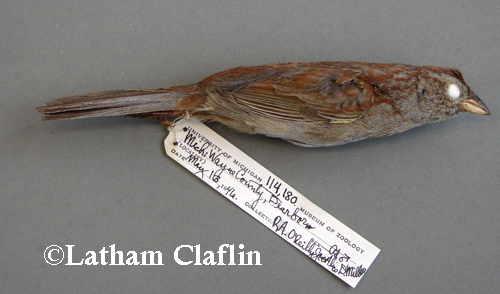
On 8 May 1946, Alice Miller discovered a Bachman's Sparrow (Peucaea aestivalis) across the street from her home. It was a singing male, and present until 13 May when it was procured as a specimen by Ralph O'Reilly. This specimen is now in the University of Michigan Museum of Zoology (a photo can be seen here).

This was the second record of this southeastern sparrow for Michigan, the first being one taken as a specimen in Erie Township, Monroe County on 29 April 1944. According to The Birds of Michigan and other sources, there were only a few additional sightings: one in Ann Arbor (Washtenaw Co.) 23-24 April 1948; one in Livingston Co. on 27 July 1954; and one in Macomb Co. on 26 April 1964.

Miller wrote a full account of this sighting, with some background on vagrancy in this species, in the Jack-Pine Warbler; following that article is a short note by O'Reilly on both individuals. You can read the PDF here.

Bachman's Sparrow in North Carolina. Photo used under a
Creative Commons Public Domain license.

Friday, January 25, 2019

European Goldfinches and other cage birds in the Western Great Lakes

European Goldfinches in Kenosha, WI, April 2016
Photo by Darrin O'Brien
  

I have posted an updated page on European Goldfinches and other non-native cage birds in the western Great Lakes. I am still collecting follow-up data while the Wisconsin Breeding Bird Atlas is in its final year of surveys; southeast Wisconsin and northeast Illinois are the "epicenters" of the breeding population of European Goldfinches. I'm working on a summary paper -- read all about the history, identification, and how to submit reports here.

Thursday, January 24, 2019

Some post-closing updates

RRBO has closed, but I am still working on several RRBO-related projects, as well as continuing to do urban ecology research independently and providing expertise and service to the scientific community. So whether you are interested in Dearborn and southeast Michigan birds; urban ecology with a focus on birds, insects, and plants in the Midwest; and/or similar endeavors, I hope you continue to follow along here!

Here are some updates:

First, I was asked to work on helping finish a really interesting bird conservation project by the U.S. Fish and Wildlife Service. My involvement was just about squared away when the government shutdown occurred. While I'm pretty sure the project will be completed one day, I have no idea when or how this will happen until after the government reopens, the people involved catch up on their work, and how their budgets shake out.

Meanwhile, I am in the process of bringing the Dearborn bird checklist up to date. There have been some taxonomy changes, and I will move any material from the RRBO website on rare or interesting birds here to Net Results, link to those items on the checklist, and publish it here. I've also been working on a substantially revised annotated checklist. More on that soon.

In April 2019, hosting for the RRBO website will be up for renewal. I pay for this hosting myself, and therefore I'm going to let it lapse. At that time, the RRBO website will be no more, and the URL will point here. I have been and will be moving some material over here to the blog, including the entire section on European cage birds that have become established in the western Great Lakes. This is research I'm continuing, and I plan on publishing another paper. I'll be posting this section shortly.

Recently, a new paper came out that drew upon data I provided. "Species interactions limit the occurrence of urban-adapted birds in cities" was published in the journal PNAS (Proceedings of the National Academy of Sciences of the United States). You can read a news story about it here. I have always strongly believed in sharing data, so even when I have not had the chance to use it in my own publications, I've been  happy to contribute to the projects of others.

Finally, I also still post pretty regularly to the RRBO Facebook page, so feel free to engage there.

Friday, August 31, 2018

RRBO is closing

Due to a lack of sustainable funding, the Rouge River Bird Observatory will cease operations in October 2018.  I will be leaving the University as a retiree with Visiting Scholar status, and hope to finish publishing RRBO-related research. I will continue to maintain this blog, and social media (Facebook) for the time being, and I'll use these venues to post updates on publications and related news, for those interested. 

I will still be collecting data on European Goldfinches! Please see this page on how to submit data. 

Finally, I sincerely thank everyone who supported RRBO in so many ways the past 26 years.


--- Julie Craves

Thursday, September 7, 2017

New major paper published

The paper Native birds exploit leaf-mining moth larvae using a new North American host, non-native Lonicera maackii was recently published online ahead of print in the journal Écoscience.

This paper describes the interactions between native birds, a specialist moth, and the moth’s new host in North America, Amur honeysuckle, a problematic non-native shrub.

On a bird survey in late fall 2015, I came across a small flock of chickadees that appeared to be finding food on the leaves of Amur honeysuckle along the Rouge River. This non-native shrub dominates the forest understory in this area, as it does over a large swath of North America east of the Great Plains. The feeding behavior was very interesting to me, as Amur honeysuckle is known to be largely free of insect herbivores, even more so than the other species of non-native honeysuckles that are so common in urban forests.

A closer look revealed that nearly every Amur honeysuckle had leaves that were heavily infested with leaf mines, and that the chickadees were opening these mines and feeding on the insects within them. This was even more intriguing! Because they live and feed within plant tissues, leaf mining insects tend to be very host-specific, and specialized insects like this were supposed to be especially rare on most introduced plants, Amur honeysuckle included.

I reared the tiny caterpillars, overwintered them, and had the emerging insects (which were moths) identified by DNA barcoding in 2016. I continued my observations on bird use of the moth larvae, the extent of the infestation, and population status in 2016. My paper details these findings, which are novel in several ways:
  • This is the first record of this moth species, or any in the same moth family of over 2000 species, using Amur honeysuckle as a host in North America
  • The native ranges of the moth and the shrub do not overlap, indicating evolutionary adaptation was involved in the host switch
  • Some of the bird species using the moth larvae have never been documented feeding on leaf mining moths
  • Because Amur honeysuckles holds leaves (with occupied mines) until well after killing frost, these larvae supply protein to birds at a time when other insects have become scarce
In the paper I also discuss the ecological implications of these interactions. I am continuing to make field observations on bird predation, and am raising moths to see which other local hosts in the same plant family they might use. One interesting fact about these moths is that they are all female. This method of asexual reproduction is not particularly common in butterflies and moths, and is not only handy for me (to raise them, I don't have to worry about pairing them off), but also means a single female can be a founder of a large population. I'm also working with a Canadian researcher on identifying the parasitoid community -- the many tiny wasps that lay eggs in the larvae within the mines; there have been four species identified so far. At least one more paper is in the works.

This link will take you to the abstract of the paper. If you'd like to read the full paper, please contact me by using the form in the footer.

Many other papers can be downloaded at my Researchgate profile.

Saturday, July 1, 2017

Odd plumages and abnormal feather growth

Birds with abberant plumage are one of the more common oddities we see at the Rouge River Bird Observatory. Abnormally-colored feathers are fairly frequent, and some examples are below. One example has its own page: a stunning white-breasted American Robin.

Plumage that is abnormally white

An an abnormal reduction in the deposition of pigment in the feathers is known as leucism. Some leucistic birds appear entirely washed out or pale if the reduction of pigment is roughly equal in all feathers (some authors now call this “hypomelanism”). More often, pigment is absent in only some feathers, and this is known as pied leucism, or “partial amelanism.” Causes include genetics, or injury, disease, or malnutrition.


Once or twice a year, we see an American Robin (Turdus migratorius) that has several white feathers or patches of white feathers. This one was photographed by Darrin O'Brien on 29 Apr 2009 at a Dearborn office complex.


This unusual American Robin was banded on 7 Oct 2007. It was an adult female undergoing its fall molt. The breast feathers were normal. However, nearly all of the incoming feathers on the wings, tail, and body that are gray in normal robins were full or partially "frosty" looking. Typically when abnormal white feathers are seen on birds, the entire feather is white, as in the first example. Partially white feathers like this are something RRBO encounters only rarely, and not to the extent found on this bird. The bird was re-sighted the following week.


A leucistic Yellow-rumped "Myrtle" Warbler (Dendroica coronata) was found at the on campus from 15 to 17 May 1997. The wings and tail of this bird were entirely white. Soft yellow was visible where most yellow-rumps have bold yellow on the flanks. The back and head were pale gray, and some pale gray streaking replaced the prominent streaking of normal-plumaged yellow-rumps. This bird appeared to be a male. While relatively common in some families of birds, abnormally pigmented individuals are rare in the Parulidae (wood warblers). This sighting was documented in the following paper: Craves, J. A. 1997. Extreme leucism in a Yellow-rumped Warbler (Dendroica coronata coronata). Michigan Birds and Natural History 4:199-200.

Plumage that is abnormally orange

Carotenoids are the pigments responsible for most of the red and yellow colors in birds. They cannot be created by birds without dietary input. Thus, the pigments in what birds eat can influence the color of their feathers. If a bird consumes particular deep red pigments while feathers are in active growth and also has yellow plumage, some or all of the yellow feathers may turn out to be orange. This is most frequently seen in the terminal tail bands of Cedar Waxwings (Bombycilla cedrorum), which are normally yellow. About 5% of the Cedar Waxwings banded by RRBO have had orange terminal tail bands (right). It was first noticed in the 1960s, and it has since been confirmed that it is due to waxwings consuming the fruit of introduced Morrow's Honeysuckle (Lonicera morrowii), which contains a red pigment called rhodoxanthin. This honeysuckle is common at UM-Dearborn. 

A number of other bird species have been recorded with orange or reddish feathers in place of yellow feathers that could be attributable to ingestion of rhodoxanthin. The White-throated Sparrow (Zonotrichia albicollis) at right was banded by RRBO on 27 September 1998. This bird has orange-colored lores rather than yellow. Subsequently, RRBO has banded two more White-throated Sparrows with orange lores, and this phenomena has also been reported by other banders. The first record was documented in the following paper: Craves, J. A. 1999. White-throated Sparrow with orange lores. Michigan Birds and Natural History 6:83-84.

Further reading:

Tricks Exotic Shrubs Do: When Baltimore Orioles Stop Being Orange (pdf) by Tom Flinn, Jocelyn Hudon, and Dan Derbyshire -- article from Birding magazine.

Diet explains red flight feathers in Yellow-shafted Flickers in eastern North America. Hudon, J., R.J. Driver, N.H. Rice, T.L. Lloyd-Evans, J.A. Craves, and D.P. Shustak. 2017. The Auk: Ornithological Advances 134:22-33.

Occasionally we have encountered Northern Cardinals (Cardinalis cardinalis) that are very vividly colored or with some orange plumage. The male on the right was banded by RRBO on 25 October 2000. It had patches of orange feathers, and several wing feathers that were orange. This abnormality may have been caused by a lack of some sort of dietary pigment that left the normally red feathers less intensely red. Dietary deficiency of certain carotenoids is responsible for orange- or yellow-colored House Finches (Carpodacus mexicanus). Perhaps some lack in the diet combined with ingestion of a red pigment like rhodoxanthin that contributed to the orange color as well as the crimson color of the red plumage.  Other orange cardinals have turned up in the literature and on the Internet, beginning in the late 1990s, lending some credence to the role of honeysuckles and rhodoxanthin in this plumage variation.

Further reading:

An 'orange variant' Northern Cardinal. (pdf) Hansrote, C. and M. 2000. North American Bird Bander 25:1-3.

And now, a white/pink cardinal! Ohio Birds and Biodiversity.

The yellow cardinal lives on. Ohio Birds and Biodiversity.


RRBO has banded a half-dozen Ruby-crowned Kinglets (Regulus calendula) with at least some orange crown feathers rather than salmon red, all since the year 2000. Examples of two individuals are shown below. This may also be due to a dietary deficiency.


Abnormally dark plumage

When birds have plumage with excess pigment, usually the dark melanin pigments, they are known as melanistic. This Mourning Dove (Zenaida macroura) was seen in the Dearborn yard of Julie Craves and Darrin O'Brien on 8 Apr 2006. The second photo shows it compared to a normally-colored Mourning Dove.


The first secondary feather on one wing of this American Goldfinch (Spinus tristus), banded 20 Aug 2010 was completely black on the underside, rather than having a white base. When melanism occurs, it seems that it typically affects all feathers. RRBO has not documented a single melanistic feather or patches of melanistic feathers on any birds, much less the thousands of goldfinches banded on campus.


More information on abnormal plumage coloration

Davis, J. N. 2007. Color abnormalities in birds: A proposed nomenclature for birders. Birding 39:36–46.

David Sibley's web site: Abnormal coloration in birds: Melanin reduction.

British Trust for Ornithology's Abnormal Plumage Survey page.

Abnormal feather growth

On several occasions, the Rouge River Bird Observatory has banded a bird that had an unusual tail.

The first was a young House Wren (Troglodytes aedon) banded on 1 Oct 2003. The tips of 5 tail feathers (rectrices, or “rects”) had unusual, spatulate tips which extended about 5 mm past the “normal” ends of the feathers.
The extensions did not appear to be formed by the wearing away of some of the feather barbs. This was the first time RRBO had ever seen a bird with a tail like this.


On 25 Aug 2008, a young Carolina Wren (Thryothorus ludovicianus) was captured that had a similar tail. This bird only had the odd paddle-like extension on the central tail feather. We recaptured this bird several times that season, and this feather was present each time.


On 5 October 2008, we banded a White-throated Sparrow (Zonotrichia albicollis). One central tail feather was around 10 mm longer than the other feathers. All the rects were fully grown in, so it wasn’t a case of the other feathers having not reached their full length.


Finally, there was the recent capture of a similar case. This adult Cedar Waxwing (Bombycilla cedrorum) also had two extra-long central tail feathers. As with the White-throated Sparrow above, all the feathers were fully grown. It was banded on 8 November 2011.


See more weird birds: